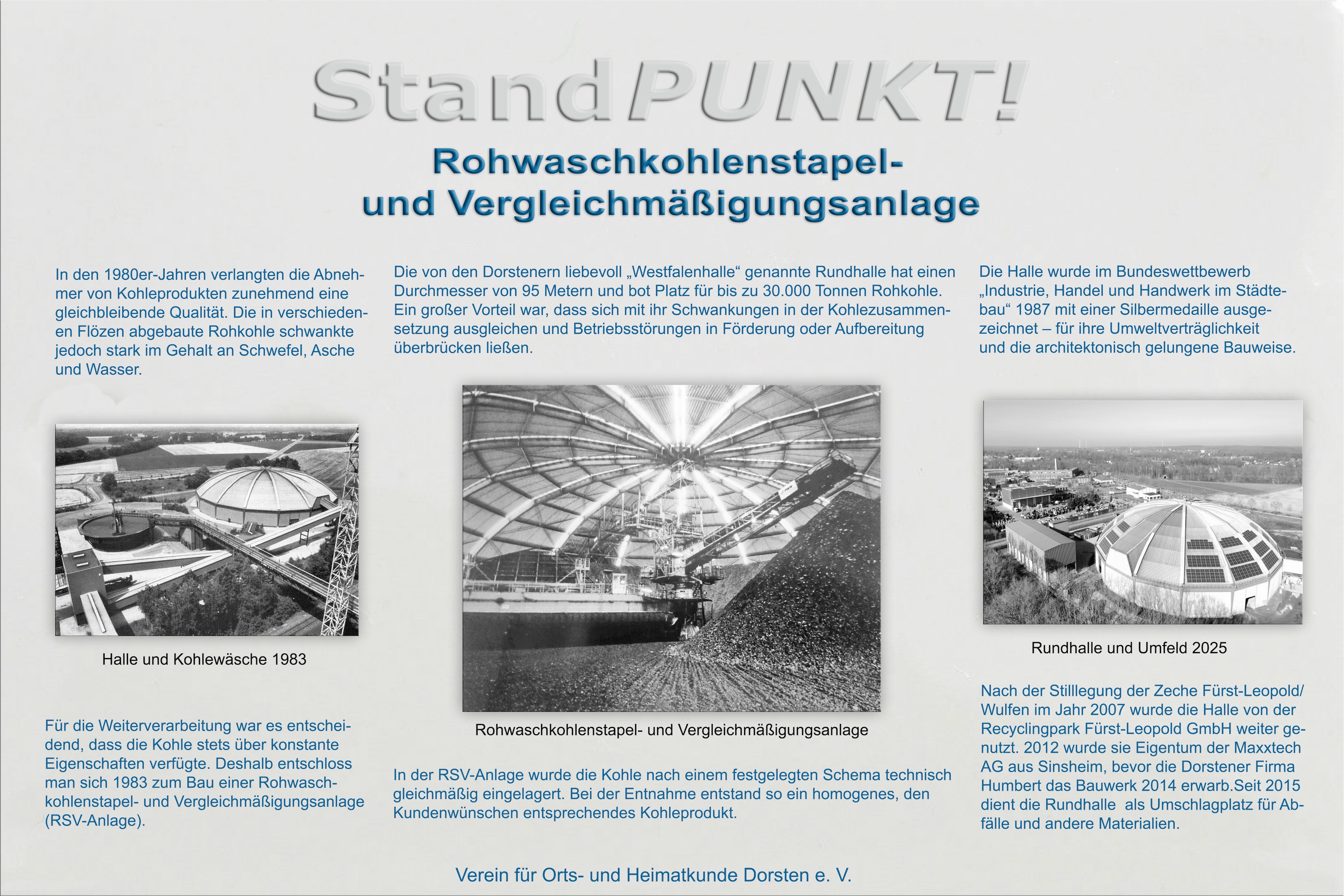
In den 1980er-Jahren verlangten die Abnehmer von Kohleprodukten zunehmend eine gleichbleibende Qualität. Die in verschiedenen Flözen abgebaute Rohkohle schwankte jedoch stark im Gehalt an Schwefel, Asche und Wasser. Für die Weiterverarbeitung war es entscheidend, dass die Kohle stets über konstante Eigenschaften verfügte. Deshalb entschloss man sich 1983 zum Bau einer Rohwaschkohlenstapel- und Vergleichmäßigungsanlage (RSV-Anlage).
Die von den Dorstenern liebevoll „Westfalenhalle“ genannte Rundhalle hat einen Durchmesser von 95 Metern und bot Platz für bis zu 30.000 Tonnen Rohkohle. Ein großer Vorteil war, dass sich mit ihr Schwankungen in der Kohlezusammensetzung ausgleichen und Betriebsstörungen in Förderung oder Aufbereitung überbrücken ließen.
In der RSV-Anlage wurde die Kohle nach einem festgelegten Schema technisch gleichmäßig eingelagert. Bei der Entnahme entstand so ein homogenes, den Kundenwünschen entsprechendes Kohleprodukt.
Die Halle wurde im Bundeswettbewerb „Industrie, Handel und Handwerk im Städtebau“ 1987 mit einer Silbermedaille ausgezeichnet – für ihre Umweltverträglichkeit und die architektonisch gelungene Bauweise.
Nach der Stilllegung der Zeche Fürst-Leopold/Wulfen im Jahr 2007 wurde die Halle von der Recyclingpark Fürst-Leopold GmbH weiter genutzt. 2012 wurde sie Eigentum der Maxxtech AG aus Sinsheim, bevor die Dorstener Firma Humbert das Bauwerk 2014 erwarb. Seit 2015 dient die Rundhalle als Umschlagplatz für Abfälle und andere Materialien.
Halle und Kohlewäsche 1983 • Rohwaschkohlenstapel- und Vergleichmäßigungsanlage • Rundhalle und Umfeld 2025
In the 1980s, customers of coal products increasingly demanded consistent quality. However, the raw coal extracted from various seams varied greatly in its content of sulphur, ash and water. For further processing, it was essential that the coal always had constant properties. For this reason, the decision was taken in 1983 to build a raw coal stockpiling and homogenisation plant (RSV plant).
The circular hall, affectionately known by the people of Dorsten as the “Westfalenhalle”, has a diameter of 95 metres and had capacity for up to 30,000 tonnes of raw coal. A major advantage was that it allowed fluctuations in coal composition to be evened out and operational disruptions in extraction or processing to be bridged.
In the RSV plant, the coal was stored in a technically uniform manner according to a set pattern. When it was retrieved, this produced a homogeneous coal product that met customer requirements.
The hall was awarded a silver medal in the 1987 Federal Competition “Industry, Trade and Craft in Urban Development” – for its environmental compatibility and architecturally successful design.
After the closure of the Fürst-Leopold/Wulfen colliery in 2007, the hall continued to be used by Recyclingpark Fürst-Leopold GmbH. In 2012 it became the property of Maxxtech AG from Sinsheim, before the Dorsten-based company Humbert acquired the building in 2014. Since 2015, the circular hall has served as a transshipment point for waste and other materials.
Hall and coal washing plant 1983 • Raw coal stockpiling and homogenisation plant • Circular hall and surroundings 2025
Dans les années 1980, les acheteurs de produits charbonniers exigeaient de plus en plus une qualité constante. Cependant, le charbon brut extrait de différentes couches présentait de fortes variations en teneur en soufre, en cendres et en eau. Pour la transformation ultérieure, il était essentiel que le charbon dispose toujours de propriétés constantes. C’est pourquoi la décision a été prise en 1983 de construire une installation de stockage et d’homogénéisation du charbon brut lavé (installation RSV).
La halle circulaire, affectueusement surnommée « Westfalenhalle » par les habitants de Dorsten, a un diamètre de 95 mètres et pouvait accueillir jusqu’à 30 000 tonnes de charbon brut. Un avantage majeur était qu’elle permettait de compenser les fluctuations dans la composition du charbon et de surmonter les perturbations dans l’extraction ou le traitement.
Dans l’installation RSV, le charbon était stocké de manière techniquement uniforme selon un schéma prédéfini. Lors du prélèvement, on obtenait ainsi un produit charbonnier homogène répondant aux exigences des clients.
La halle a été récompensée d’une médaille d’argent lors du Concours fédéral « Industrie, commerce et artisanat dans l’urbanisme » en 1987 – pour sa compatibilité environnementale et sa conception architecturale réussie.
Après la fermeture de la mine Fürst-Leopold/Wulfen en 2007, la halle a continué à être utilisée par le Recyclingpark Fürst-Leopold GmbH. En 2012, elle est devenue la propriété de Maxxtech AG de Sinsheim, avant que l’entreprise dorstenoïse Humbert n’acquière le bâtiment en 2014. Depuis 2015, la halle circulaire sert de point de transbordement pour les déchets et autres matériaux.
Halle et lavage du charbon 1983 • Installation de stockage et d’homogénéisation du charbon brut • Halle circulaire et environs 2025
In de jaren tachtig stelden afnemers van kolenproducten steeds hogere eisen aan een gelijkblijvende kwaliteit. De uit verschillende lagen gewonnen ruwe kolen varieerden echter sterk in gehalte aan zwavel, as en water. Voor de verdere verwerking was het essentieel dat de kolen steeds over constante eigenschappen beschikten. Daarom werd in 1983 besloten tot de bouw van een ruwe-kolenopslaginstallatie en -homogeniseringsinstallatie (RSV-installatie).
De ronde hal, door de bewoners van Dorsten liefkozend „Westfalenhalle“ genoemd, heeft een diameter van 95 meter en bood ruimte aan maximaal 30.000 ton ruwe kolen. Een groot voordeel was dat daarmee schommelingen in de kolensamenstelling konden worden opgevangen en verstoringen in de winning of verwerking konden worden overbrugd.
In de RSV-installatie werden de kolen technisch uniform opgeslagen volgens een vastgelegd schema. Bij de afname ontstond zo een homogeen kolenproduct dat beantwoordde aan de wensen van de klanten.
De hal werd bij de Bondswedstrijd „Industrie, handel en ambacht in de stedenbouw“ in 1987 bekroond met een zilveren medaille – voor haar milieuvriendelijkheid en architectonisch geslaagde ontwerp.
Na de sluiting van de mijn Fürst-Leopold/Wulfen in 2007 werd de hal voortgezet door Recyclingpark Fürst-Leopold GmbH. In 2012 werd zij eigendom van Maxxtech AG uit Sinsheim, voordat het Dorstense bedrijf Humbert het gebouw in 2014 verwierf. Sinds 2015 dient de ronde hal als overslagpunt voor afval en andere materialen.
Hal en kolenwasserij 1983 • Ruwe-kolenopslaginstallatie en -homogeniseringsinstallatie • Ronde hal en omgeving 2025
W latach osiemdziesiątych odbiorcy produktów węglowych coraz bardziej domagali się stałej jakości. Jednak węgiel surowy wydobywany z różnych pokładów znacznie różnił się zawartością siarki, popiołu i wody. Dla dalszego przetworzenia kluczowe było, aby węgiel zawsze dysponował stałymi właściwościami. Dlatego w 1983 roku zdecydowano się na budowę instalacji składowania i homogenizacji surowego węgla (instalacja RSV).
Okrągła hala, czule nazywana przez mieszkańców Dorsten „Westfalenhalle“, ma średnicę 95 metrów i mogła pomieścić do 30 000 ton surowego węgla. Dużą zaletą było to, że można było za jej pomocą wyrównywać wahania w składzie węgla i kompensować zakłócenia w wydobyciu lub przetwarzaniu.
W instalacji RSV węgiel był technicznie jednorodnie składowany według ustalonego schematu. Podczas poboru powstał w ten sposób jednorodny produkt węglowy odpowiadający wymaganiom klientów.
Hala została nagrodzona srebrnym medalem w Ogólnoniemieckim Konkursie „Przemysł, handel i rzemiosło w urbanistyce“ w 1987 roku – za przyjazność dla środowiska i architektonicznie udaną konstrukcję.
Po zamknięciu kopalni Fürst-Leopold/Wulfen w 2007 roku hala była nadal użytkowana przez Recyclingpark Fürst-Leopold GmbH. W 2012 roku stała się własnością Maxxtech AG z Sinsheim, zanim dorstenska firma Humbert nabyła obiekt w 2014 roku. Od 2015 roku okrągła hala służy jako punkt przeładunkowy dla odpadów i innych materiałów.
Hala i mycie węgla 1983 • Instalacja składowania i homogenizacji surowego węgla • Okrągła hala i otoczenie 2025