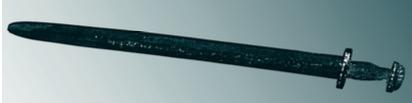
Ceremonial Sword of Lembeck |
8./9. Jh |
A settlement consisting of single farms, called Helinun, is recorded in the leaseholder register of the Monastery of Werden (889-890). It was located in the Midlicher Muhlbachtal, now the Beck neighbourhood. During excavations in 1925 and focused archaeological explorations from 1938, numerous burial objects were found, including the “Ceremonial Sword of Lembeck”. |
| 1017 |
The placename “Lehembeke” is mentioned for the first time, in a donation document from Emperor Henry II to the church of Paderborn. |
|
| Ferdinand III unites Castile and Léon | 1217 |
The parish of Lembeck, consisting of about 900 people, is mentioned for the first time. It covered the area from Reken to Holsterhausen and from Altschermbeck to Lippramsdorf. |
| 1526 |
The von Lembeck family of House Lembeck dies out and is succeeded by the von Westerholt family, through the marriage of a daughter of the von Lembeck family. The last members of the von Westerholt family extended and expanded the castle between 1670 and 1692. In 1708 a daughter of the von Westerholt family brought the castle into the von Merveldt family. |
|
| 1598 |
During the Eighty Years’ War, mercenaries plunder the village and cause great damage. |
|
| 1612 | The first elementary school is established in the castle. | |
In England King George I dies, who has simultaneously bee 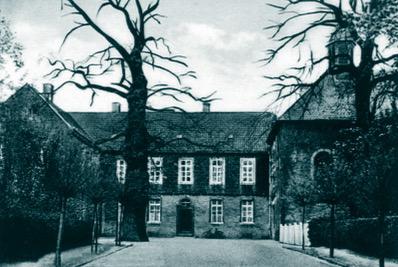
St Michael’s Foundation Hospital |
1727 |
In this year the chapel of the St. Michael´s Foundation, designed by Johann Schlaun, is officially opened, as the headquarters of the charity foundation for the widowed Baroness Westerholt in the Endeln area. After the building had been extended by a hospital (1842) and an orphanage (1844), the Sisters of St. Clement took over the task of nursing. After the closure of the orphanage (1977) and the old people´s home (1995), Carmelite nuns moved into the St.Michael´s Foundation. |
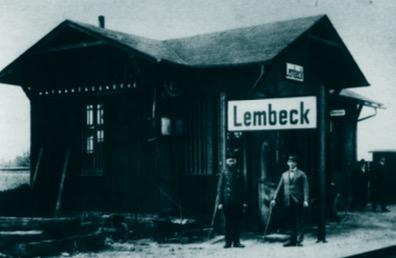
Lembeck Station |
1878 |
The Oberhausen - Coesfeld railway line is built. In 1902 Lembeck got a train stop which was later expanded into a station. |
| 1927 |
A new building for the Laurentius School (expanded in 1968 and 1984) is opened. The bricks which were not needed were used to build a new village well, which existed until the end of the 1960s. |
|
Hitler uses the Berlin Olympics to promote the Third Reich 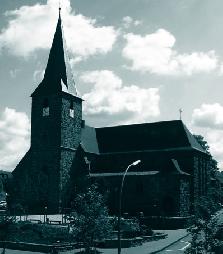
St Laurentius’ Parish Church |
1936 |
The fifteenth-century St. Laurentius’ Church is reconstructed as a “cruciform church” and is considerably enlarged with the help of numerous donations. Its glory was renewed after another reconstruction and renovation in 2007. |
| 1945 |
Towards the end of the war, the village and the castle suffer from bombardments, heavy fire and looting. |
|
| 1975 | Due to local government reorganisation, Lembeck becomes part of Dorsten. | |
| 2000 | After extensive preparations and private engagement the former teachers´ house of the Laurentius School is repurposed as a home for disabled people. | |
| 2003 | Supported by private donations and activities (the ZIGL-project), the attic of the Don Bosco elementary school is converted into classrooms. | |
| 2007 | The Lembeck old people´s home is completed. | |
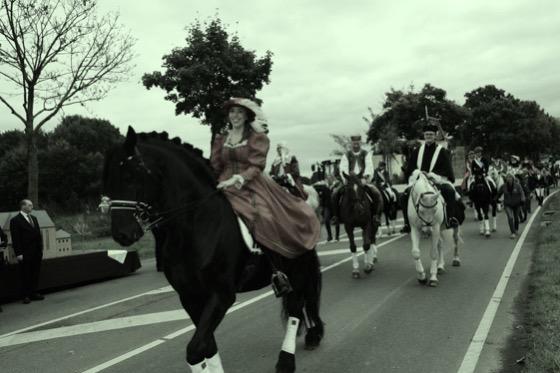
2017 Triple Jubilee |
2017 |
The start of the festive parade on 8th October 2017: riders in historical costume lead the parade. Throughout the year Lembeck celebrates the 1000th anniversary of its foundation and St. Laurentius parish its 800th. Lembeck castle was completed in its present form 325 years ago. |
Eröffnung:
18. Oktober 2008
Adresse:
Geodaten:
51°45'32.0N 6°59'57.7E