


The local historian from Rhade, Fritz Oetterer, gave just a short insight into the history of Rhade. Ad the weather conditions caused the visitors to shiver a bit, the group went into the building where the local historical society is housed and continued to listen to the speech of the local historian whilst enjoying sandwiches and drinks.
To start with, 30 History Stations were planned in Dorsten but as time past it became clear that this would not be enough. There are five new History Stations planned for the near future and a further five have been requested. For this, the exact circumstances need to be considered. One day, there will certainly be around 40 History Statioms giving an insight into and an overview of the history of Dorsten.
Translator's note: The source is given as egg Quelle Dorstener Zeitung - 24.11.2007
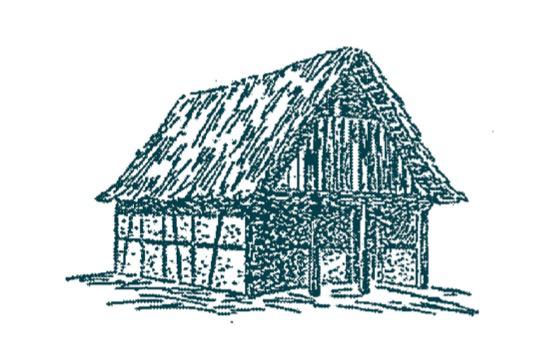
The building "Rhader Haus" (ca. 300 A.D) |
1500 v. Chr. | Archaeological findings show that the area around Rhade was already inhabited during the Bronze Ages. |
| 1217 | The place name of Rhade ("Rothe") is found mentioned documentally for the first time, allocated to an agriculturally cleared field | |
| Carl IV gives permission for a land register of the Brandenburg Marches "Mark Brandenburg" to be created. | um 1375 | The first chapel is probably erected during this time. |
| 1489 | The Chapel Parish of Rhade is independent, following the separation from the original parish of Lembeck. | |
| 1571 - 1621 | During the Reformation and Counter-Reformation, the population is subjected without any protection to the pillaging and plundering mercenaries of the powers fighting against each other. | |
| 1773 | The first school building is erected on the northern side of the church called "Urbanuskirche". | |
| Napoleon created the Confederation of the Rhine | 1806 | The population fled from Napoleon's troops to Hoßkalverkamp, a place of refuge surrounded by the river "Rhader Bach". |
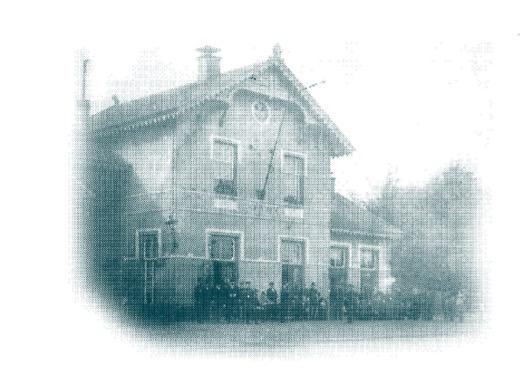
Station (around 1920) |
1880 | On 15th June, the railway connection between Winterswijk and Gelsenkirchen is inaugurated; Rhade then has its own station. |
| 1945 | On 28th March, the Allied Forces take over the place, Rhade, without any particular incidents, | |
| 1966 | The church "Heilig-Geist-Kirche", originally erected as a provisonal church and then extended in 1974, is the centre of the Christian Protestants, "evangelische Christen". | |
| Troops of the Warsaw Pact brutally end the Spring of Prague "Prager Frühling". | 1968 | The Catholic elementary school is closed. Following the school reform, only the Catholic Primary School remains at the location. |
| 1974 | The District Council decides on the erection of the sport centre at "am Dahlenkamp", before Rhade is incorporated into Dorsten in 1975. | |
| 1976 | At the address "Am Stuvenberg / Am Kalten Bach" the Catholic Church of St Ewald is consecrated. | |
The Eastward Expansion of the EU is contractually regulated.. 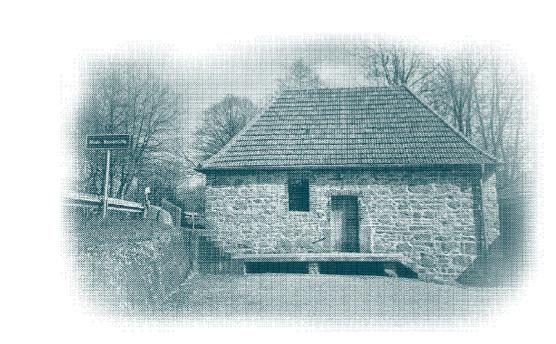
Water Mill |
2003 | The water mill, originating from the 14th century and in restoration by the local History Society since 1999 is made open to the public. |
Eröffnung:
23. November 2007
Adresse:
Close to the church named "Urbanuskirche".
Geodaten:
51°45'01.73 ,6°55'44.3
"Rhade - Now the small rebellious nation in the North of Dorsten has its own History Station" ( „Rhade - Nun hat das kleine aufmüpfige Volk im Dorstener Norden seine eigene Geschichtsstation."). With these words, the Mayor, Mr Lütkenhorst, greeted the guests to the offical opening ceremony on Friday afternoon.
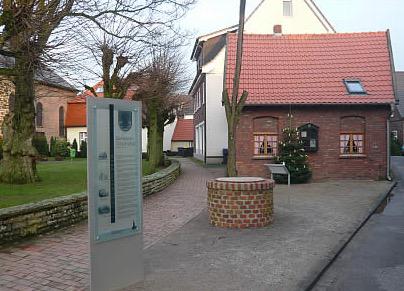
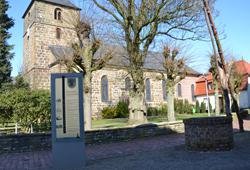
History Station next to the historic fountain.
The History Station Board "Rhade" is the 28th History Station in Dorsten.
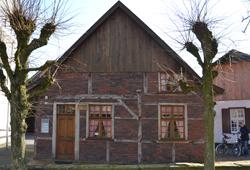
The building "Soggeberghaus"
It stands close to the building "Soggeberghaus", next to the church "St Urbanus".
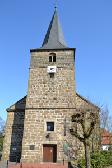
The Church "Urbanuskirche"
Club of the Petrinum Grammar School, the Lions Club Dorsten Hanse and the Local History Society of Rhade.
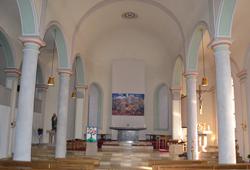
Interior View
The two A'level students, Alexander Endemann and Christian Labetzsch took a particularly active part.
Overall View
