


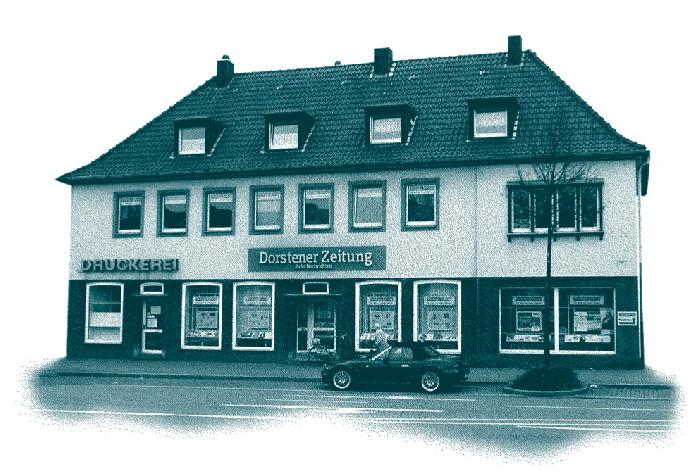
The newspaper "Dorstener Zeitung" sponsors a history station about the theme of newspapers, as a way of celebrating its special birthday jubilee. For Dorsten's largest daily newspaper belongs to Dorsten's history like butter does to bread.
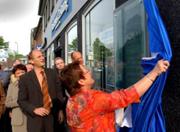
At the end of April, the plaque, attached to the building of the "Dorstener Zeitung" at "Südwall 27" is revealed. This plaque is the result of a joint initiative between the local history society "Heimatvereins Dorsten und Herrlichkeit Lembeck e.V" and the Petrinum school's history club. It gives information ranging from about how the first edition was published in 1804 up to the modern local newspaper of today and relates this to historical events in the rest of the world.
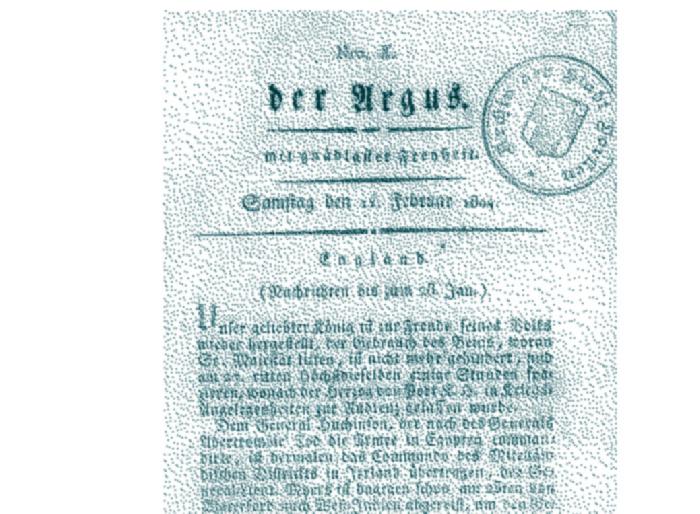
„Argus“, 1804 |
1804 | Karl August Schüerholz (1775-1831), bookseller and bookbinder of Dorsten, publishes the newspaper "Argus, von politischen, gemeinnützigen und gelehrten Sachen" ("Argus, about things political, of public interest and scholarly") |
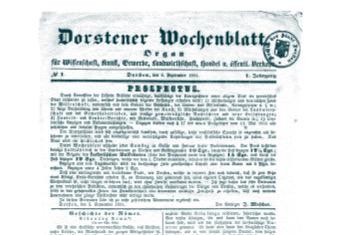
Dorsten's weekly newspaper - first edition |
1848 | Mescher, bookbinder and pasteboard worker, creates the politically moderate newspaper "Concordia", out of which, in 1851, the newspaper "Dorstener Wochenblatt" develops. |
| Pasteur publishes his research about lactic acid and alcohol fermentation. | 1857 | Mescher sells his printing works and the newspaper to Matthias Joseph Reichartz. |
| 1863 | Franz Drecker, a teacher at the Petrinum, publishes the first Catholic newspaper "Dorstener Anzeiger" in the district of Recklinghausen. The newspaper appears, in 1866, with the sub-title "Katholisches Organ für Stadt und Land" ("Catholic Voice for Town and Country"). | |
| 1903 | The publisher's daughter, Katharina Reichartz, who has managed the business since the death of her father in 1897, oversees the move of the printing works to Südwall. | |
| 1913 | Reichartz sells the business to Joseph Weber. The "Dorstener Volkszeitung und Wochenblatt" ("Dorsten's Local Newspaper and Weekly Newspaper") (renamed in 1909) is now published daily. | |
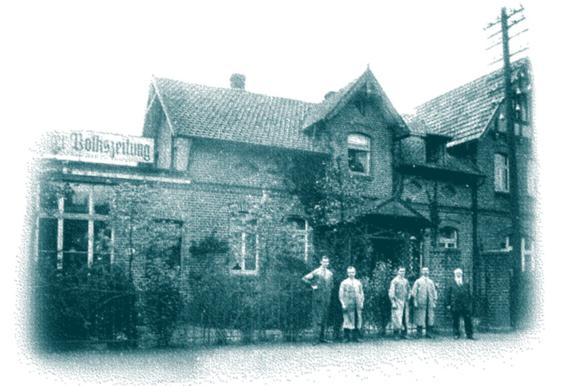
Publishing House on Südwall around 1925 |
1923 - 1925 | The "Dorstener Volkszeitung" ("Dorsten's Popular Newspaper") is not allowed to be published during the French-Belgian occupation. |
| Japan leaves the League of Nations. | 1933 - 1934 | The politically moderate "Dorstener Volkszeitung" ("Dorsten's Popular Newspaper") has to succumb to the National Socialist "forcing into line" politics and swing in the direction of the NSDAP. NS-(National Socialist) publications, such as the "Generalanzeiger" and the "Nationalzeitung", which are also published with a local news section, cannot beat the popularity of the "Dorstener Zeitung" right up until 1945. |
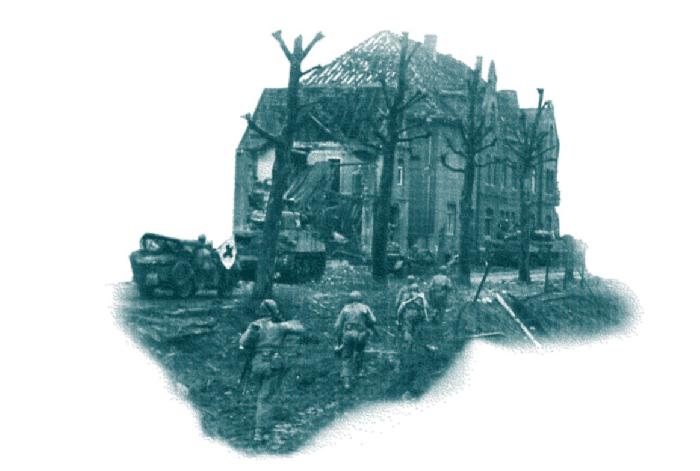
Publishing House in 1945, when the Allied Forces enter |
1945 | Julius Hülswitt leases the printing works and the publishing house from Joseph Weber. In 1949, he joins the "Ruhr Nachrichten" group (Dortmund). The "Dorstener Volkszeitung" is now called the "Ruhr Nachrichten - Volkszeitung für Dorsten und die Herrlichkeit". |
| Martin Luther King, the American civil rights campaigner, is shot by a stranger. | 1968 |
The "Westdeutsche Allgemeine Zeitung" is published with a local news section for Dorsten. |
| The dictatorship in Spain is over, following the death of General Franco. | 1975 | The "Ruhr Nachrichten" takes over the publishing company of the "Dorstener Volkszeitung / Dorstener Zeitung". |
| The East-West Conflict is officially over. | 1997 | The daily newspaper "Ruhr-Nachrichten" carries the name "Dorstener Zeitung" in Dorsten. |
Eröffnung:
29th April 2004
Adresse:
Dorstener Zeitung, Südwall 27
Geodaten:
Dziennik "Ruhr-Nachrichten" nosi w tym miejscu nazwę "Dorstener Zeitung". 51°39'32.2 6°57'55.1
200 Jahre „Zeitung in Dorsten“. Das ist ein Grund zum Feiern.
