


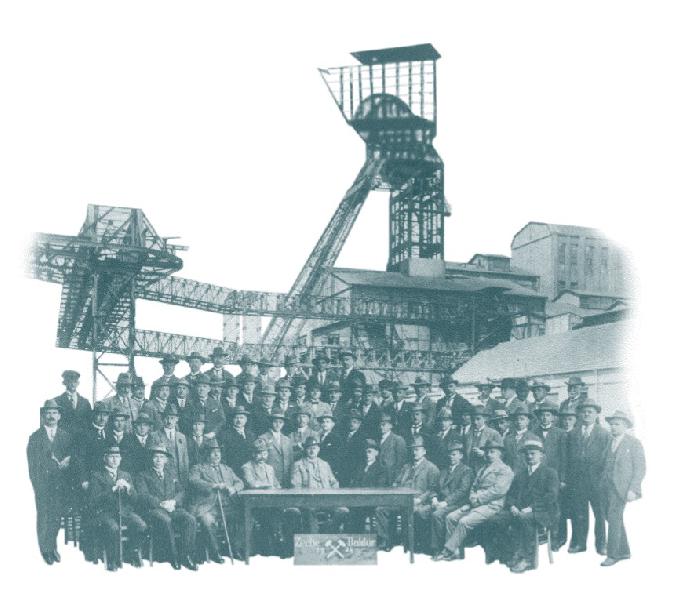
Baldur Colliery was a coal mine in the Holsterhausen district of Dorsten, north of the river Lippe.
The great grandparents or grandparents of many local families first came here to work in the mine. The colliery was closed during the Great Depression.
Coal extraction continued through a connection to the nearby Prince Leopold mine.
.
| Carl Zeiss constructs the first stereo microscope. peter | 1897 | The mining company Gewerkschaft Trier begins trial borings for the Baldur colliery in Holsterhausen. |
| The Norwegian Roald Amundsen reaches the South Pole shortly before Captain Scott, who died on the return trek. | 1906 | February: Ground-breaking for the Baldur Nr. 1 and 2 shafts. Shaft Nr. 1 reaches its initial depth of 722 m in 1910. Sinking of Nr. 2 shaft is terminated at 602 m due to thick strata of quicksand. |
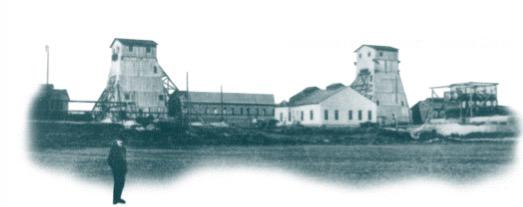
Freezing plant for sinking the shaft (1909) |
1911 | 4,993 tonnes of coal are extracted in the first year of production. |
Henry Ford introduces the conveyor belt to car production. 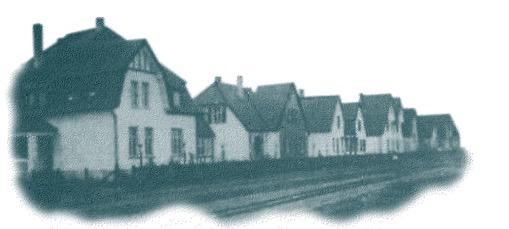
Workers’ housing |
1913 | The colliery builds an estate of 60 houses for its workers. Extraction begins at the Prince Leopold mine in Hervest-Dorsten. |
| The Treaty of Versailles is signed. | 1919 | The “Trier I – V” and “Holsterhausen” claims are consolidated to form the “Baldur” claim, with a total area of 9.6 km². |
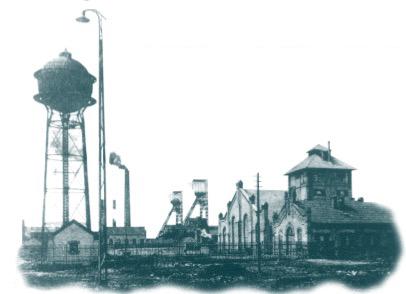
In the foreground, water tower and brickyard (1923) |
1924 | Increasing use of machinery in operations in the following years. |
Gustav Stresemann and Aristide Briand are awarded the Nobel peace prize. 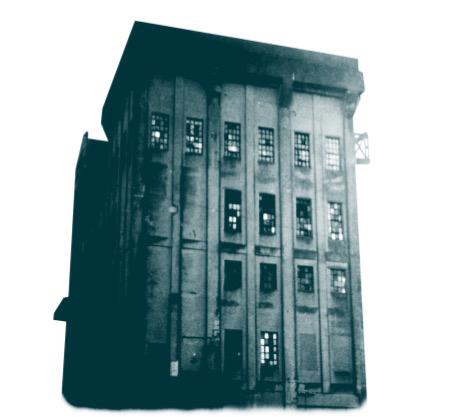
Coal washing plant |
1926 | A coal washing plant improves profitability and the quality of the “black gold”. |
| Japan occupies Manchuria. | 1930 - 1931 | For economic reasons the Baldur pithead is closed and the coal workings are combined with the Prince Leopold mine. |
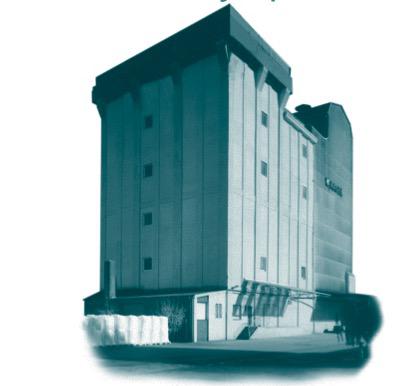
Grain silo of the company Wilhelm Nagel GmbH & Co KG |
1935 | The Wilhelm Nagel company (today, Wilhelm Nagel GmbH & Co KG) uses the former coal washing plant as a grain silo. |
| seit 1950 | In the following years, the Nagel company expands further on part of the former colliery site. | |
| 1954 | Baldur Nr. 2 shaft is filled in. | |
| The 20th Olympic Games take place in Munich. | 1972 | The Ruhrkohle concern has the former brickworks demolished. |
| 1991 | Baldur Nr. 1 shaft, at 1,328.4 metres the deepest in the Prince Leopold/Wulfen colliery, finds a new use as a ventilation shaft. | |
| 2002 | After production ceases at Prince Leopold, Baldur Nr. 1 shaft is filled in. |
Eröffnung:
27th April 2003
Adresse:
Nagel company, Baldurstrasse
Geodaten:
51°40'18.74 ,6°56'58.47
The mayor
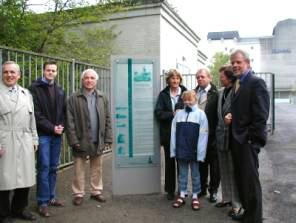
The mayor thanked all involved: teachers and school students of the history group, Franz-Josef Stevens (college) and Annegret Tüshaus (ad agency), the Lions Club Dorsten-Hanse, and especially the Nagel family which sponsored the new history station.
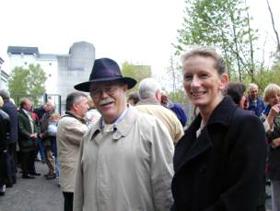
Franz Josef Stevens
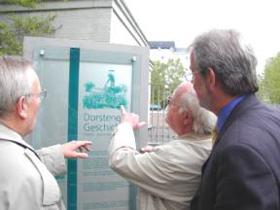
H.-Jochen Schräjahr, Hermann-Josef and Lambert Lütkenhorst (mayor) recognise some of their forebears among the pictured miners.
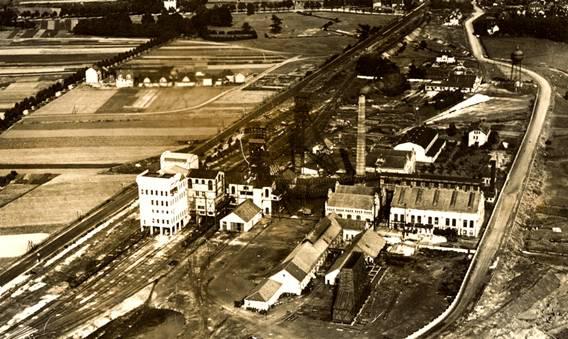
Aerial photograph c.1926/7: View of the pithead area between the railway line from Wesel & Schermbeck to Hervest-Dorsten (diagonal from left to right) and Baldurstrasse. (Municipal archive)
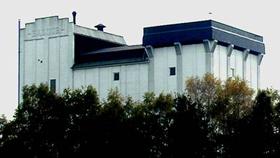
Though faded, the name “BALDUR” on the shaft head tower is still visible from afar. The street names Baldurstrasse and Knappenweg (Miners’ Way) in Holsterhausen also recall the colliery.
