


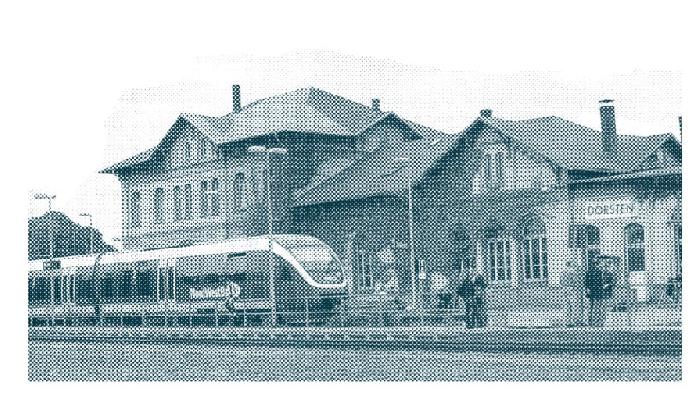
In front of an audience of around 50 interested listeners, Mayor Tobias Stockhoff recalled a historic premiere that took place exactly 135 years ago next door: On July 1st, 1879, the first train arrived at the newly built Dorsten railway station.
This event, along with other key moments in the town’s railway history, is now commemorated by the 39th Dorsten History Station. Stockhoff warmly thanked Dr. Josef Ulfkotte for his significant contribution to keeping history alive and bridging the past with the present through these commemorative plaques placed at special locations around the city. Ulfkotte plays a dual role as “station manager”: he is both the chairman of the Local and Regional History Association and the leader of the history working group at Petrinum High School, which is responsible for the content of the stations.
Special thanks also went to the Lions Club Dorsten-Hanse and its president Stephan Reken, who provided the necessary funding for the project.
Another group was also involved in the station at the railway site. The railway association On Wheels contributed their expertise to the project. That’s why it was On Wheels chairman Manfred Diekenbrock who had the honor of giving a speech on the significance of the railway and the station for Dorsten, highlighting some unique facts.
Diekenbrock, a true railway enthusiast, spoke with great passion. And his joy was evident when he pointed out: “Never before have so many passengers used the train here as they do today!”
(Report by Klaus-Dieter Krause, Dorstener Zeitung)
| 1874 |
Hervest gains a connection to the Hamburg–Venlo railway line. Starting in 1879, this line intersects with the Duisburg–Oberhausen–Quakenbrück railway, and from 1880 also with the Wanne–Winterswijk line. Since then, Hervest-Dorsten station has been an important railway junction. |
|
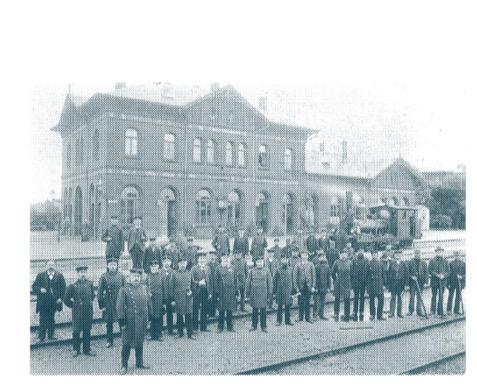
Station, 1892 |
1879 |
With the opening of the Duisburg – Quakenbrück railway line by the Rhenish Railway Company, the station building in Dorsten is made accessible to the public. |
| The Titanic sinks on her maiden voyage. | 1908 - 1912 | The station is expanded in several construction phases into a major freight transport hub on the northern edge of the Ruhr area. |
| 1923 | Belgian troops occupy the railway stations in Dorsten (until 1925) and Hervest-Dorsten (until 1924). Rail traffic comes to a temporary halt. | |
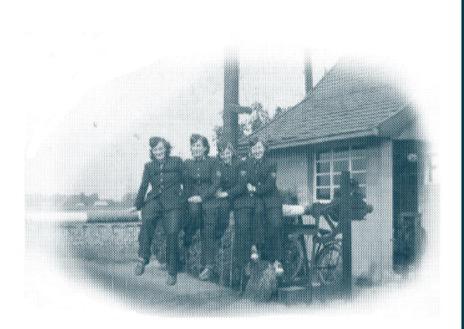
Women as railway signal operators, 1942 |
1926 |
As part of the canal construction, work begins on the new railway bridges over the Lippe River and the canal. Two years later, the old masonry Lippe Bridge from 1879 is demolished. |
Civil war breaks out in China between the Kuomintang and the Communists. 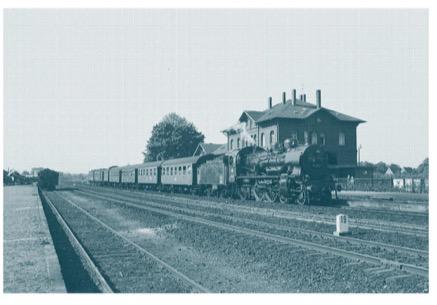
Passenger train to Borken |
1945 |
Pioneers of the Wehrmacht destroy the bridges over the Lippe River and the canal to hinder the advance of the Allies. After the reconstruction of the first railway bridge, train service between Dorsten and Hervest-Dorsten can resume in May 1948. |
| 1960 |
The Deutsche Bundesbahn (DB), founded in 1949, discontinues passenger service between Dorsten and Osterfeld-Nord. Two years later, passenger transport on the Haltern – Wesel line is also terminated. |
|
| Willy Brandt is awarded the Nobel Peace Prize. | 1971 |
Following the decommissioning of the (western) connecting curve between Hervest and Dorsten, all freight transport toward Bottrop-Nord is discontinued in 1974. |
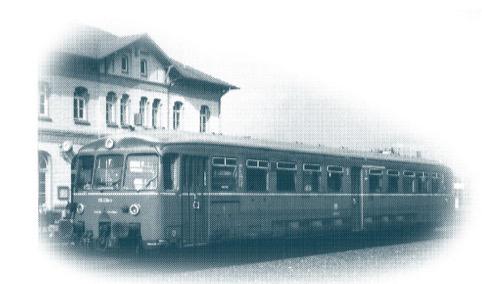
Battery-powered railcar, around 1980 |
1985 | The Deutsche Bundesbahn discontinues freight transport to Schermbeck. Since the 1990s, the former railway line has been converted into a bicycle path. Freight transport to Haltern is discontinued in 1988. |
| The People's Republic of China decides to purchase the "Transrapid" high-speed train developed in Germany. | 2001 |
The joint-stock company "Deutsche Bahn" (German Railways) transfers local public transport services to the private company "Prignitzer Eisenbahn." Five years later, the company "Nordwestbahn" takes over additional local public transport services. |
Eröffnung:
02. Juli 2014
Adresse:
Geodaten:
In front of the station building
“This is a first for me. This is the first history station I am unveiling,” began Mayor Tobias Stockhoff.
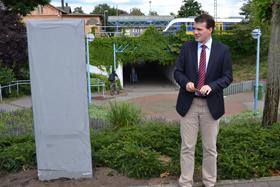
The keynote speaker
In front of around 50 interested listeners, he then recalled another premiere that had taken place exactly 135 years earlier just next door: on July 1, 1879, the first train arrived at the new Dorsten station.
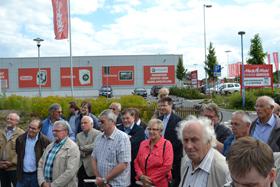
Great public interest
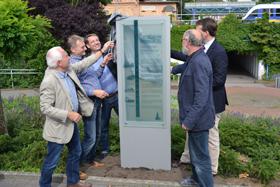
The unveiling
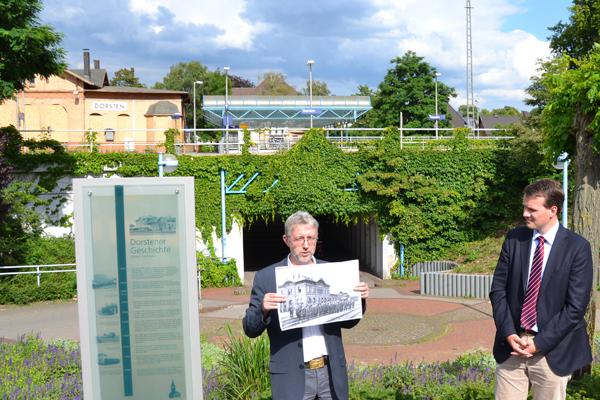
Präsentation von Manfred Diekenbrock
On Wheels chairman Manfred Diekenbrock gave a presentation on the importance of the railway and the station for Dorsten.
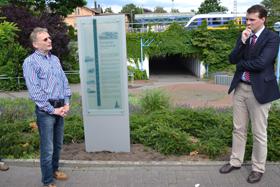
Echte Eisenbahrfreunde
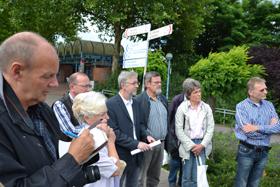
Publikum und Pressearbeit
